It brings together useful things to do with reading and vocabulary.
I hope that you can learn enjoyably by browsing the information I have collected. Maybe you already love one of the books that I have chosen; and in that case, the book can be your doorway or diving-board into understanding and remembering vocabulary words, thereby making learning the words easier and more fun.
Of course, if you haven’t read the books yet, perhaps the website will inspire you to read more.
I have tried to avoid all spoilers, so sometimes names are blocked out of the examples. Beware of spoilers from other websites that I’ve recommended via the bibliography and links though.
These can be found by links next to some of the words and are intended to be printed and adapted for use as learning resources, for example like this: I am still working on these and hope to add more.
Introduction: Continuous footways are designed to make walking, wheeling, and cycling easier, more efficient, and more pleasant for all, to slow down turning traffic and to keep pedestrians and cyclists safe. They reflect and reinforce the pedestrians’ right of way and the requirement for traffic turning at the entrance to a side street to stop and give way. The physical features of a steep ramp up for vehicles, sharp corner and narrow lane width force turning traffic to a near stop far more effectively than the traditional “stop” sign and highway code alone. Meanwhile there’s no step down for people walking and wheeling and the footpath paving continues, enabling us to make uninterrupted progress along the footway without having to stop at every T-junction to look out for traffic. If there’s a cycleway, that is also continuous with right of way for people going straight on, raised higher than road level and protected by a steep ramp or drop curb. The road surface stops, to reinforce visually to drivers that they are about to enter a pedestrian space.
This design is safe and effective and much of the evidence for this comes from The Netherlands where it is seen very commonly. I am fully in support of having continuous footways here, but, like other active travel infrastructure, success depends upon the design details, and I have some concerns that if these design details are wrong, this could negate the benefits seen with the continuous footways in the Netherlands.
The old design for T-junctions in most cities in the UK (with continuous roadway and discontinuous footway) is less convenient for pedestrians and at odds with the current Highway Code rules. Pedestrians naturally stop at the curb, and this is sensible because there’s little to prevent traffic rounding the corner dangerously.
I am worried about potential confusion caused by footways that are neither the conventional design nor truly continuous. I call these not-quite-continuous footways. I don’t think these have an evidence base supporting their use, I cannot find any study showing that they are as safe as the continuous footway. Just because a continuous footway is safer than a conventional turning it does not necessarily follow that a not-quite-continuous footway will be safer. It might be more dangerous than both. Although the pedestrian has the same right of way in both cases, I don’t think it’s safe to continue on at a conventional turning because the driver is seeing the space as a “road” and people drive mostly on system 1 thinking and not on conscious analysis of the Highway Code all the time. In other words, they will see a “road” and drive onto it. In a not-quite-continuous footway, the driver might still see it as a road, especially if it is a similar colour to the road. The pedestrian might see it as a conventional turn, and stop naturally as we do when we come to a road (notwithstanding the right of way they have) or they might see it as a continuous footway and keep going. If this is confusing for humans, it’s possibly worse for non-humans; guide dogs are trained to stop at a curb, and would presumably carry on along the footpath, but what about a not-quite-continuous footway? I have read one observation that some guide dogs stop and others don’t.
The Highway Code is clear, but if the infrastructure doesn’t clearly match that, there’s going to be more confusion, more hesitations where both stop and more “forced yields” of pedestrians – precisely what the continuous footway is designed to prevent. There might even be more collisions, which is not the case with the properly continuous design. Since a wise person learns from the mistakes of others, I have listed some common design flaws found in the UK and elsewhere.
Mistake 1: The footpath and road colours are confusing: either because they’re too similar or because the road surface is continuous and the footway colour is not continuous, even when other features are continuous. Drivers must see (as well as know and feel) that they are driving into a footpath and not a road.
In practice, more often, car drivers do notice the unfamiliar layout but they treat it as “shared space”. They’re slowing down alright, but when they see pedestrians hesitate, they just roll on, taking the right of way and making pedestrians wait. The importance of having a continuous footway and not a shared space is that here, there is a clear right of way for pedestrians going straight ahead, they should not need to behave any differently from being on a standard footway. They make progress quickly and easily along the path without confusion. Shared space, on the other hand, relies on seeing other road users and so it is unsuitable for visually impaired people, and also can be difficult those with hearing impairment. The shared space concept also relies on vehicles slowing right down, but some vehicles, such as SUVs and lorries, are still a threat to life even at very low speeds.
Mistake 2: The footpath surface is hard-going and tiring for wheelchair users (little paving blocks).
Mistake 3: The street is being used as a rat-run and the rat-runners are not respecting the pedestrians’ right of way. This should be addressed before building a continuous footway because it could be dangerous, and because another design solution might be the answer, such as a modal filter.
Mistake 4: The footpath surface is getting damaged by vehicles and may become hazardous.
Mistake 5: The ramp part is not steep enough to force all vehicles to slow down to a near stop. This is an important factor and we already know that rules, enforcement and signage aren’t enough to stop some drivers. Addition of physical structures such as bollards to narrow the lane may be needed slow the larger vehicles.
Mistake 6: There isn’t enough distance between the ramp that slows down the cars and the pedestrians – the front of the bonnet could be very close before the car stops. There’s an optimal distance though, because if too far away, the visibility advantage would be lost – pedestrians, (esp children, wheelchair users) on a higher level than approaching vehicles.
Mistake 7: Either the right-angle turn isn’t tight enough, or drivers are able to smooth it out by going onto the footpath too early.
There shouldn’t be any obstacle to wheelchairs and pushchairs, no curb or change in height, that’s usually done alright.
Mistake 8: A small minority of drivers are failing to stop. In the example I saw, these were a few taxi drivers licenced and regulated by the council.
Debatable: I have read that this one is debatable, some say if the footpath is properly continuous, there should be no need for the textured paving, though blind people may need something to inform them of the side street to orient themselves? There also needs to be some indicator to prevent someone from veering off the footpath down the ramp or dropped kerb onto the road.
In conclusion: The reason we have continuous footways is to improve the convenience and comfort for all pedestrians and cyclists, including and perhaps especially those with impairments. It’s vital to ensure this is not at the expense of safety for any street users, and in fact continuous footways should improve safety compared with conventional design. They should also help the attractiveness of the street for anyone who sees it and the ease of travel for all.
Right of way for pedestrians and the infrastructure that supports it are one step towards easing the perverse economic incentive structures that encourage driving. Who hasn’t reached for the car keys in an effort to make up when they realised they were running five minutes late? Who hasn’t driven their child to a destination that they could have reached on foot if only the footway were safe and continuous? Who doesn’t regularly take time-consuming detours to avoid the externalities of motor vehicles? Who hasn’t inhaled dangerous smog whilst waiting for car after car to pass a pelican crossing?
We know it is possible to design city centre road junctions to be safe. And by “safe” I don’t mean “so scary that nobody except the fittest and ablest dares to cross on foot or bicycle” but rather “you’d be confident to walk through backwards and blindfolded” or at least that we don’t fear for our children on their own way to school.
It’s important to ensure that everyone’s point of view is taken into account and that nobody’s special needs are ignored in the design process. Decisions should be based on the best possible evidence and care should be taken to ensure safety in every detail.
The following books will help to inform, empower and encourage us. The list is far from complete, and of course, any and every book can inspire us, and feed our imagination, but these I think have a specific bearing on current crises, without focusing on melting ice sheets and extinction. I tried to list them in some kind of order of relevance, but that’s subjective.
From What Is to What If, by Rob Hopkins
The Good Ancestor, by Roman Krznaric
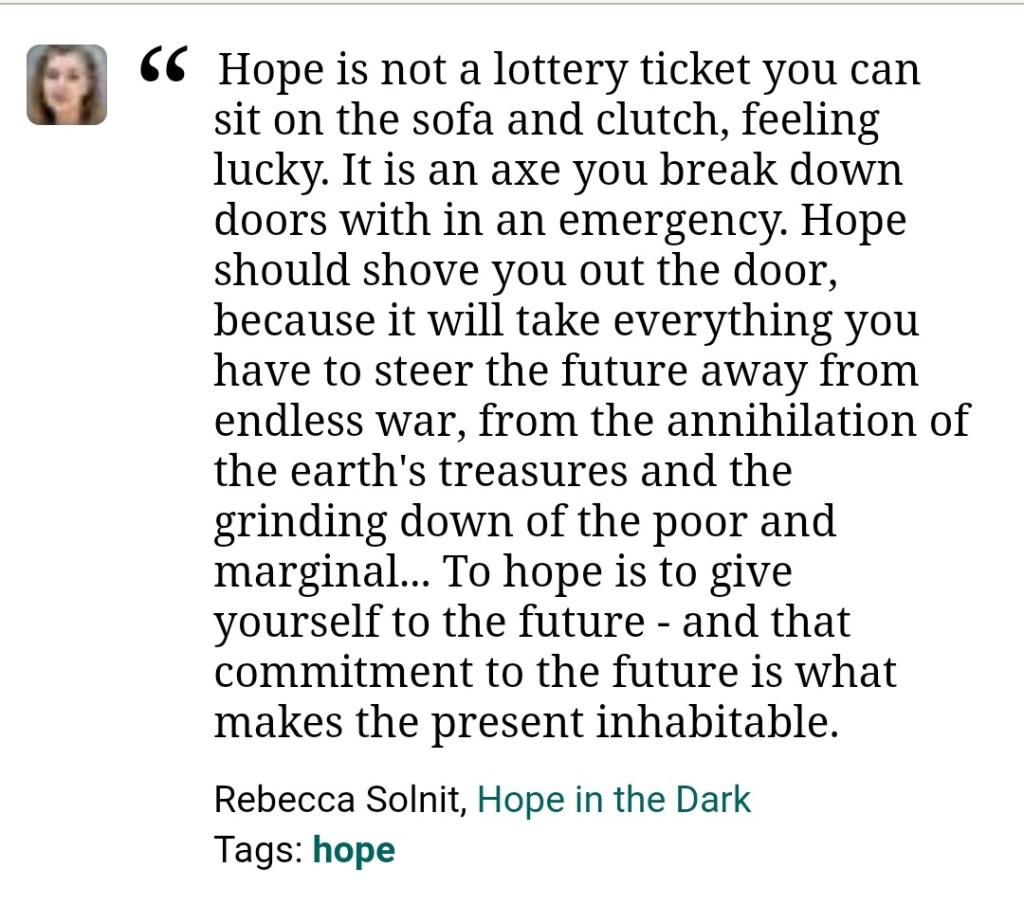
Building Paradise in Hell, and Hope in The Dark, both by Rebecca Solnit
Doughnut Economics, by Kate Raworth.
Lost Connections, by Johann Hari
Angrynomics, by Eric Lonergan, Mark Blyth
The Hedgehog and the Fox, by Isiah Berlin
Conflicted, by Ian Leslie
The Anatomy of Peace, by the Arbinger Institute
Wilding, by Isabella Tree
Don’t Even Think About It, by George Marshall
A subject that comes up occasionally during discussions is that a friend or family member has been caught up in one of the current conspiracist “theories”.
I recommend this book, as helpful, readable and informative: Escaping the Rabbit Hole, by Mick West.
The aims of this group will be to read and discuss books. Appreciate the importance of ideas and the need for all kinds of them and sharing them. Feeding ideas into community groups and civil society. Promote resilience. Empowering people. Education for human flourishing. Fulfilling people’s need for challenging intellectual engagement as well as social engagement.
For people of any age, ability or background to increase their knowledge by reading and discussing the books. Provide a safe space for sharing information, trying out and challenging opinions, and questioning narratives.
To improve our skills in communicating and evaluating ideas.
To provide and build ideas useful in civil society, volunteer groups, local economy, promote resilience.
To build metaphorical bridges between all people who want communities here in the Highlands to thrive.
To build context for all future conversation by expanding everyone’s inner library of concepts. (A low context discussion is one where every concept that’s mentioned needs to be explained because there’s little knowledge in common. A good example of high context may be found at the end of each chapter of “Thinking, Fast and Slow” where Kahneman imagines office workers at a water cooler referring to the concepts he has just introduced.)
Build resilience against harmful ideas and their influence.
Format
Agree Rules
Because we discuss ideas and arguments, I suggest the following rules for contributors and organisers.
No hate speech. Obviously, no racism, including Antisemitism and Islamophobia. No hate towards political opponents, or based on any physical features, income level, sexuality, etc. No calling for any person(s) to be killed. Respect for democracy and human rights.
Openness. I hope people will wish to attend regularly but this is not a requirement and there is no restriction on who can attend.
Rejection of the “Argument is War” conceptual metaphor. This is of central importance.
We recognise that the weaker argument contributes as well as the stronger. Human cognition is a collaborative process.
Safe space. Respectful disagreement, not reporting outside the group without the contributor’s permission. Respect and encourage changes of opinion. All have different starting points.
No question is stupid. No shaming. Ask if you don’t understand. Everyone making progress from different starting points. Politely correct any unintentional language errors made when referring to ethnic groups etc. By the same token, be uninhibited to introduce any knowledge you think might be helpful.
No top-down management, no hogging the conversation, decisions by consensus.
Accessibility. Providing assistance for anyone too old, young, physically or financially constrained or whatever to attend by themselves.
Inclusive and tolerant of diverse opinions (except hate).
Guidelines for good debate.
Owning your opinion – for example, say “I think x” not “Any reasonable person thinks x”.
Don’t claim that your opinion is common sense, or that there is no alternative to it, or that it is supported by God, by Nature, by human nature, by silent majority, centre ground, etc, etc.
Listen to dissenting voices.
Suggested books which I have read in recent years and think would be interesting to discuss. Most are available as paper, e-book, and audiobook.
I chose books that introduce ideas and concepts or help us to understand and discuss them.
For example, the books about depression, boredom, listening, or drug addiction might add some depth and breadth to any community group involved with the general public, and also add context to thought and discussion when these topics might come up, day to day. There are other books about the quirks of ‘normal’ human psychology.
Books about the challenges that some people in our community are facing, such as disability, racism, poverty, will help build understanding and make connections.
Books about the far right and other forms of Radicalisation, and about how people become drawn down ‘rabbit holes’ and how to counter disinformation may help us to be a positive influence.
Reading a story about a community showing resilience and resourcefulness in the face of a threat can inspire us in creating our own resilience.
Some of the books I have included are about the natural world, plants, animals, ecosystems, and some about the man-made world, economics, design, architecture. Some are more specifically about ideas.
Some are books about historical events or more broadly, historical ideas.
Some books are about thinking, arguing and disagreeing. These, once the group has read them, could be thought of as core texts, and providing further context for future discussion.
List in no particular order:
From What Is to What If, by Rob Hopkins
Thinking Fast and Slow, by Daniel Kahneman
Conflicted, by Ian Leslie
Seeing Like a State, by James C Scott
Escaping the Rabbit Hole, by Mick West
Angrynomics, by Eric Lonergan, Mark Blyth
Doughnut Economics, by Kate Raworth.
The Word for World is Forest, by Ursula K Le Guin (a novel).
On Tyranny by Timothy Snyder
Rule Makers, Rule Breakers by Michele J Gelfand
The Hedgehog and the Fox, by Isiah Berlin
Mindware, by Richard E Nisbett
Poverty Safari, by Darren McGarvey
The Righteous Mind, by Jonathan Haidt
Factfulness, by Hans Rosling
Building Paradise in Hell, by Rebecca Solnit
The Design of Everyday Things, by Don Norman
Essays, by George Orwell
Lost Connections, by Johann Hari
Flat Earth News, by Nick Davies
When Money Dies, by Adam Fergusson
The Bystander Effect, by Catherine Sanderson
The Windrush Betrayal, by Amelia Gentleman
Unspeakable, by Chris Hedges
The Anatomy of Peace, by the Arbinger Institute
How To Listen, by Katie Colombus, The Samaritans
The Good Ancestor, by Roman Krznaric
Becoming Wild, by Carl Safina
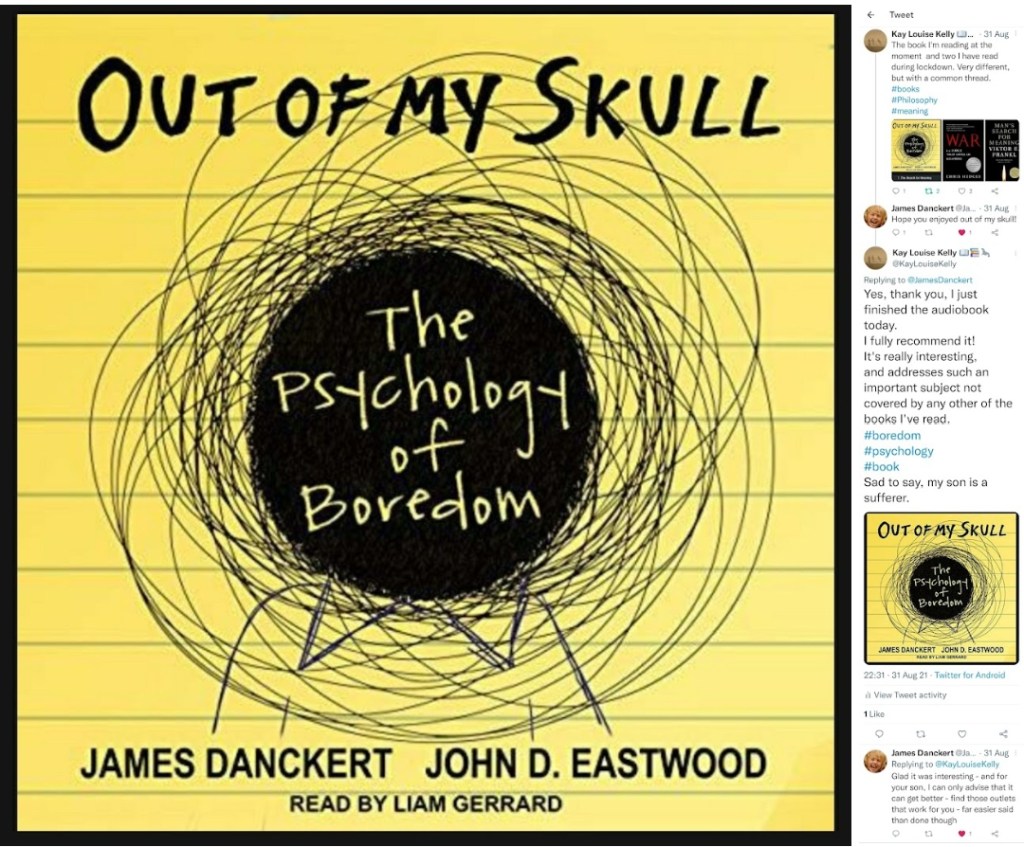
Out of My Skull, by James Dankert, John D Eastwood
Entangled Life, by Merlin Sheldrake
Moral Politics, by George Lakoff
Wilding, by Isabella Tree
Don’t Even Think About It, by George Marshall
The Better Angels of Our Nature, by Steven Pinker
Man’s Search for Meaning, by Victor E Frankl
Hood Feminism, by Mikki Kendall
Crippled, by Frances Ryan
Invisible Women, by Caroline Criado-Perez
Whistling Vivaldi, by Claude M Steele
Strong Men, by Ruth Ben-Ghiat
The Culture Code, by Daniel Coyle.
Discussing the idea with some of the first founding members of the reading group, we suggested this book as suitable for the first discussion. “Out of my Skull, The Psychology of Boredom” by James Dankert and John D Eastwood.From What Is to What If, by Rob Hopkins. This is my suggestion for the second book to discuss. It is packed with ideas of proven worth. It really inspired me to imagine a better future than ecocide and totalitarian rule. I hope it will inspire us all to achieve a more healthful and sustainable world.
Actions speak louder than words, and what we encourage children to do, and eat, will have far more impact than information we tell them.
The pupils selling Fair Trade Kit-Kats may be confused* and not alone in this. The attempt to confuse is quite deliberate, so please let me explain. We ourselves need to think critically if we are to teach our children to do so.
Nestlé is NOT a fair trade company. Only 1% of its cocoa is certified Fair trade. Nestlé does NOT support human rights.
Nestlé Fair trade Kit-Kat benefits the 6,000 farmers who are in the scheme, but millions of people outside the scheme are dependent on Nestlé.
*A survey carried out by Baby Milk Action showed: “There was widespread confusion about the meaning of the Fair trade mark as two-thirds of respondents said if they saw the mark they believed it indicated there were no significant ethical concerns about the company. In truth, the certification process only involves checking the practices surrounding the product on which the mark appears.”
¨ Child Labour
In 2001, Nestlé faced criticism for buying cocoa from the Ivory Coast and Ghana, which may have been produced using child slaves.
According to an investigative report by the BBC, hundreds of thousands of children in Mali, Burkina Faso and Togo were being purchased from their destitute parents and shipped to the Ivory Coast, to be sold as slaves to cocoa farms. The Ivory Coast is the biggest producer of cocoa worldwide. These children, ranging in age from 12 to14 years (and sometimes younger) were being forced to do hard manual labour 80 to 100 hours a week, paid nothing, barely fed and beaten regularly. Nestlé expressed its ‘concerns’ over the use of child labour but could not confirm that none of its chocolate was derived from slave-labour sources.
Although in 2001 Nestlé agreed to the Harkin-Engel protocol for ending child slavery in its cocoa supply chain within 5 years, it has been taken to court by US campaigners for failing to deliver. The International Labour Rights Fund brought the legal action against Nestlé on behalf of children in the Ivory Coast using US legislation on ‘crimes against humanity’. According to ILRF, Nestlé is not denying child slavery is taking place, nor is it denying it is complicit in this. Its defence to the legal action is that child slavery is not a “crime against humanity” and so not covered by the US legislation.
¨ Aggressive Marketing of Breast Milk Substitutes
According the World Health Organisation Authority (WHO) 1.5 million babies die every year as a result of inappropriate feeding. Aggressive marketing by companies is one of the reasons babies are not breastfed. Despite this Nestlé continues to push its baby milks in breach of international standards. Nestlé knows that babies fed on formula are more likely to become sick than breastfed babies and in poor settings they are more likely to die. Yet it is promoting its formula with logos claiming it ‘protects’ babies.
Monitoring by groups on the ground around the world shows Nestlé is responsible for more violations than any other company.
¨ Palm Oil
Greenpeace launched a campaign in 2010 against Nestlé’s sourcing of palm oil for products like Fairtrade Kit-Kat, which it claims is destroying rainforests in Indonesia, contributing to climate change and endangering orang-utans. Nestlé has promised to stop – by 2015!
¨ The Ethiopia Scandal
Just before Christmas 2002, Oxfam revealed that Nestlé was demanding millions of dollars in compensation from Ethiopia – when the country was in the midst of an extreme drought that put over 11 million people at risk for starvation.
¨ Illegal Extraction of Ground Water
Nestlé production of mineral water involves the abuse of vulnerable water resources. In the Serra da Mantiqueira region of Brazil, home to the “circuit of waters” park whose groundwater has a high mineral content, over-pumping has resulted in depletion and long-term damage. In 2001, residents investigating changes in the taste of the water and the complete dry-out of one of the springs discovered that Nestlé/Perrier was pumping huge amounts of water in the park from a well 150 meters deep. Although Nestlé lost the legal action, pumping continues as it gets through the appeal procedures, a legal process which could take ten years.
¨ Draining Developing Countries’ Groundwater to Make Bottled Water,
In Pakistan, Nestlé is sucking up the local water supply, making entire villages uninhabitable in order to sell mineral water to the upper class, while the poor watch wells run dry and their children fall ill.
In the small village of Bhati Dilwan, villagers have watched their water table sink hundreds of feet since Nestlé moved in. Children are getting sick from the dirty water that is left. Meanwhile, Nestlé spends millions marketing “Pure Life” to wealthy Americans, Europeans, and Pakistanis who can afford to watch their kids grow up healthy.
¨ Breaking EU Rules Designed to Protect Children
As EU Member States launched a new EU Action Plan on Childhood Obesity on 26th February 2014, Nestlé has admitted to violating EU Commission rules regarding its sponsorship of activities in schools.
The eight actions in the Plan include the protection and support of breastfeeding, tougher rules on marketing to children (0-19 years), and a ‘no sponsorship rule’ that aims to ensure that schools are ‘protected environments’. The EU Platform has been an ongoing initiative of the EU Commission since 2005 with the aim of tackling the obesity, heart disease and diabetes epidemic – chronic diseases that are strongly linked to the marketing of unhealthy processed foods.
It’s willingness to violate the rules on school sponsorship is telling. Corporations know there is a lot to be gained. In children’s and parents eyes, school and teachers have authority and legitimacy and can lend this to their brand by association.
¨ Intimidating Trade Unionists in Colombia
¨ Refusing to Accept Court Rulings in the Philippines over workers’ rights.
¨ Numerous Pollution Incidents.
¨ Fraudulent Labelling in South America
¨ Bad for Our Children
These highly sugared, heavily marketed products are believed by some experts to be addictive. They cause obesity, heart disease and diabetes, are implicated in cancers, and are bad for the teeth.
¨ Extreme Right-Wing Agenda
Nestlé’s chairman, Peter Brabeck, is on the record saying that he doesn’t believe there is a human right to clean water. It should be marketed just as any other foodstuff.
If you agree with that then ‘vote’ for him by purchasing Kit-Kat and other Nestlé products, but please don’t encourage my child to do so!
Would you like to sponsor the British Science Festival?
Visit their website and click through to find a tempting offer: “Opportunity for your company to be involved in Festival programming – highlighting your current agenda”.
The British Science Association’s dual aims of promoting the public understanding of science and promoting its sponsor’s current agenda could come into conflict with each other.
An apparent conflict of interest. But why is that important?
Well, the Science Festival receives extensive press coverage. A private company who gets to decide what goes into the British Science Festival programme (or who stays out) has a hidden influence on our national conversation. It is potentially changing public priorities in a democracy, and drawing attention away from vital issues facing the human race today.
The public understanding of Science is a cultural activity, educational and fun, but it doesn’t stop there. It is vital for our national community to understand and debate the major scientific issues of the day.
The existence of the conflict of interest is enough to raise serious doubt.
Moral questions.
Countless people are already suffering extreme hardship from the effects of human-induced climate change. It claims 300 000 lives per year in a current estimate by the Global Humanitarian Forum.
Institutions all over the world are disinvesting from fossil fuel companies for moral reasons. The British Science Association has raised moral concerns by collaborating with the fossil fuel industry, even if it were only by lending them publicity.
“Let us hope it is not true, but if it is, let us pray that it will not become generally known.”
– Attributed to the Bishop’s wife on hearing of Charles Darwin’s new theory. Thankfully, this didn’t stop Thomas Huxley debating the theory at the British Association in 1860.
We live in different times now. The prayer now has a more sinister sense. It is not a prayer but a business strategy. It is happening in the UK and elsewhere.
The last line of James Hansen’s famous paper on atmospheric CO2: “The greatest danger is continued ignorance and denial, which could make tragic consequences unavoidable.”


 Making Ripples